
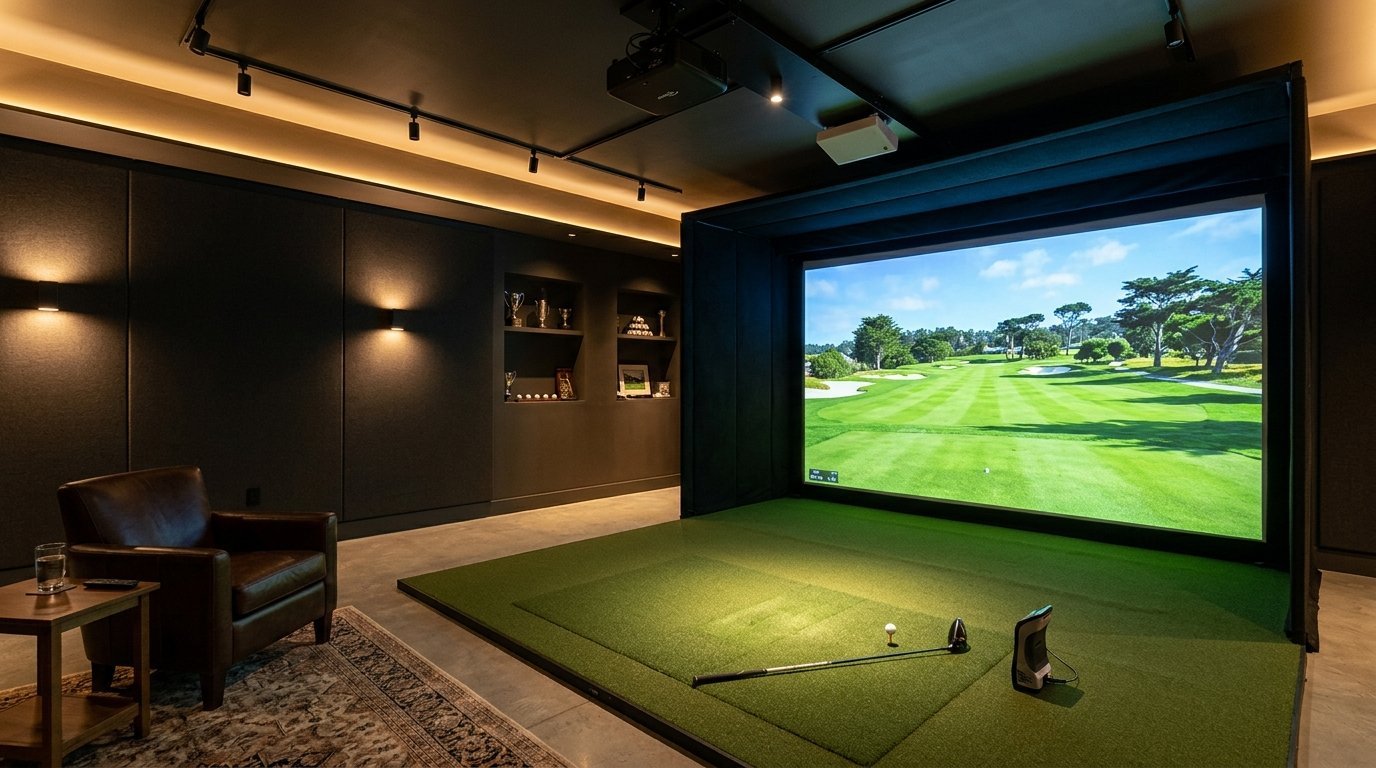
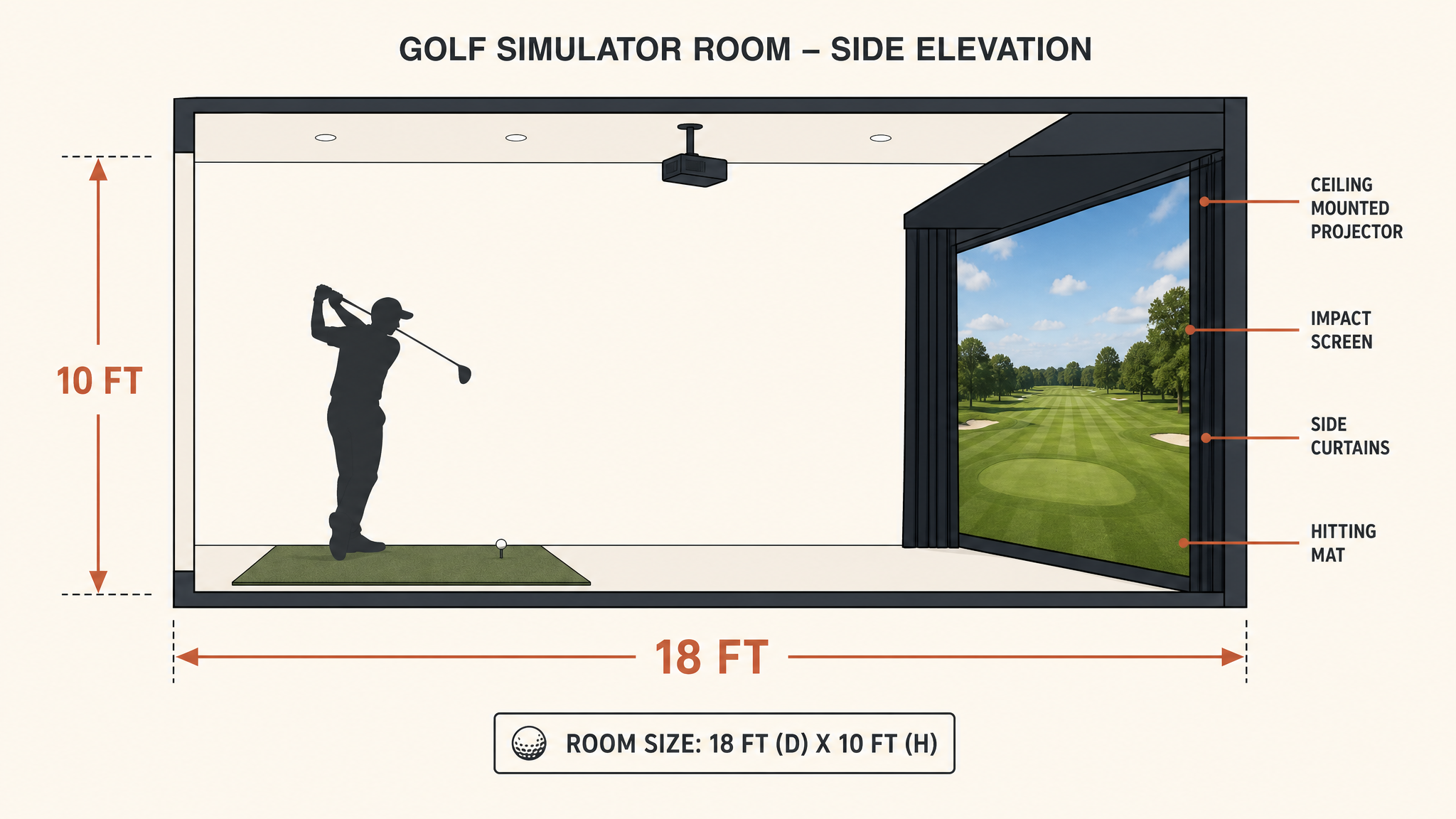
Golf simulators now appear in 25 percent more U.S. home listings than a year ago, and pickleball courts have matched that jump (Zillow’s 2026 analysis). Both face a constraint a card table never does: clearance. A full swing needs about a 10-foot ceiling and 18 feet of depth, and most spare bedrooms fail that test.
These are homes actively for sale that advertise a simulator as a selling point, so the jump reflects real demand, not wishful interest. A quarter more of them in one year means the feature is shifting from novelty to expectation in the mid and upper market.
Clearance, Not Budget, Decides a Golf Room
The single most common mistake is choosing the equipment before measuring the room. A swing that clips the ceiling or a radar unit with too little space behind the ball produces bad data and, worse, holes in the drywall. The depth requirement in particular changes with the launch monitor you pick, so measure first and buy second.
Source: Compiled from 2026 golf simulator space guides (Trackman, Carl’s Place, Home Performance Lab). A comfortable all-round room is about 10 ft high, 14 ft wide, and 18 ft deep.
What a Home Golf Simulator Actually Costs
Once the room clears the dimension test, cost is a question of how realistic you want the experience. The gap between a functional setup and a tour-grade one is almost entirely the launch monitor and the software behind it.
Source: Compiled from 2026 US golf simulator pricing guides. Figures are all-in planning ranges for equipment plus a basic room finish, not installation quotes.
Golf Simulator or Backyard Pickleball Court?
Zillow logged the same 25 percent listing jump for pickleball, but the two projects solve opposite problems. A golf simulator is an indoor conversion that fits inside a spare room or garage.
A pickleball court is the reverse: an outdoor build that needs land. The USA Pickleball recommended footprint is 30 by 60 feet, and a full backyard court averages about $34,000, most of it the concrete or asphalt base.
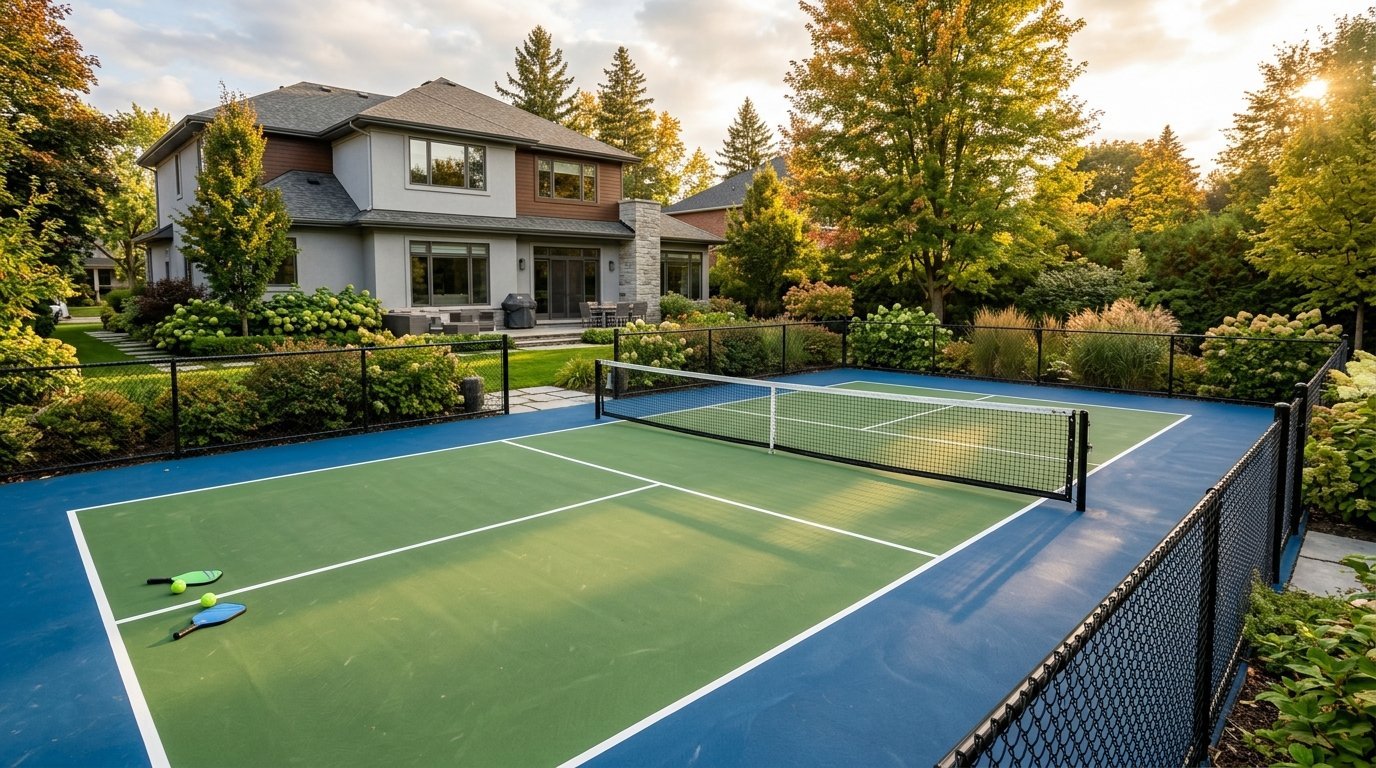
The choice usually comes down to what you already have. A tall basement or a deep garage points to a simulator; a large, flat yard points to a court.
Forcing either into the wrong space is where the money gets wasted, which is what a scale model catches before the deposit clears. If tabletop games are more your speed, the same space math applies to a dedicated game room conversion.
The Resale Reality: Lifestyle First, Value Second
A golf simulator is a lifestyle purchase, not a value play for most homes. One licensed appraiser with 30 years of experience puts it bluntly: unless you find the one-in-a-hundred buyer who wants a sim, it adds no appraised value. To everyone else it reads as a bonus room that needs converting back.
In the luxury segment the math softens. Some sellers report 65 to 85 percent cost recovery, listings with recreational tech draw more views, and buyers who golf will pay for a setup they do not have to build.
The safe move is the same as any specialty room: keep the conversion reversible so the space still reads as a flexible bonus room, and treat the enjoyment as the real return. It helps to know how a visualization step pays for itself against the cost of a room that has to be redone.
Measure These Four Things Before You Buy
- 1Ceiling height at its lowest point. Measure under beams, ducts, and light fixtures, not just the open span. One low duct can rule out a driver.
- 2Depth, then pick the monitor to match. If you only have 15 feet, choose a photometric unit. Radar needs 18 feet or more; buying it for a shallow room wastes both.
- 3A dedicated electrical circuit. A projector, monitor, PC, and lighting on one shared circuit will trip the breaker. Plan the load early, using an electrical checklist for a room renovation.
- 4The swing tested in a 3D model. A scale render shows whether the arc clears the ceiling and whether a left-handed guest fits, the same way it catches a layout problem in a kitchen before the walls move.
Common Questions About Home Golf Simulators
QCan I put a golf simulator in a room with an 8-foot ceiling?
Only for short irons and putting practice. A full driver swing arcs above 9 feet for most adults, so an 8-foot ceiling means clipped swings and a cramped, frustrating setup. If 8 feet is all you have, plan around wedges and chipping rather than a full bag.
QIs a garage a good place for a golf simulator?
Often the best place, because garages have the depth a spare bedroom lacks. The two catches are ceiling height (many garages sit at 8 to 9 feet) and climate: insulation and heating or cooling turn a seasonal space into a year-round one, and both add to the budget.
QWhat is the cheapest setup that still feels realistic?
A mid-range build in the $7,000 to $12,000 range is where most golfers stop feeling like they compromised. Budget setups under $5,000 work for casual swings, but the launch monitor accuracy and course-play software in the mid tier are what make practice translate to the course.
The Takeaway
Golf simulators and pickleball courts are both up 25 percent in listings, but a simulator lives or dies on clearance: about 10 feet of ceiling, 14 feet of width, and 15 to 20 feet of depth depending on the launch monitor. Measure the room before you shop, because the monitor you can afford is the one your depth allows.
Treat it as a lifestyle room, not a resale bet, and keep the conversion reversible. Test the swing in a 3D model first: finding out the driver clips a duct costs nothing on screen and thousands after the screen is mounted.

